
Harassment Prevention Pack
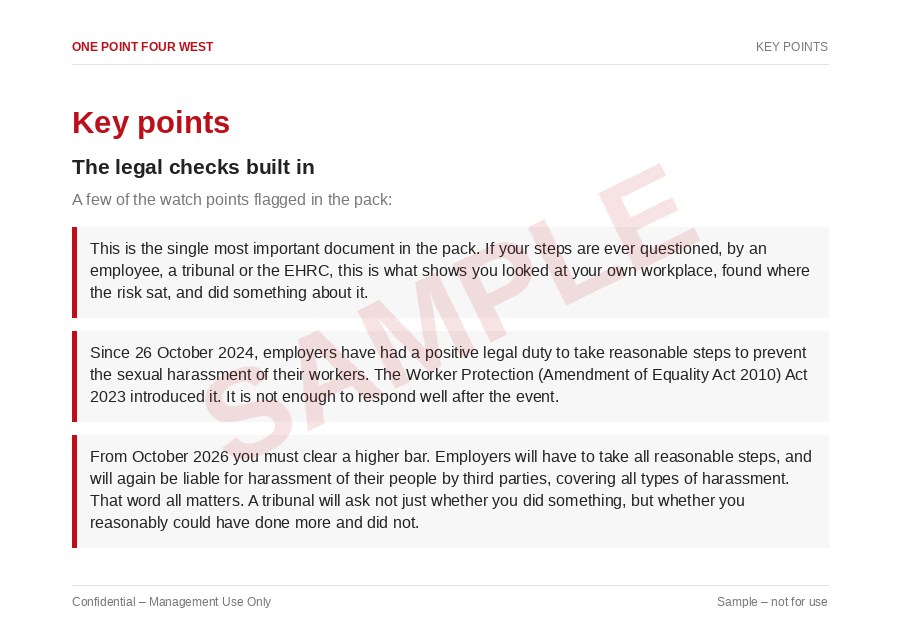
It is no longer enough to respond well after harassment happens. Since October 2024, employers have had to take reasonable steps to prevent sexual harassment. Since 30 October 2026 they must take all reasonable steps, and they can be liable for harassment by customers and clients unless they took all reasonable steps to prevent it. This pack gives you the evidence base: 15 documents plus a training deck you can brand and adapt, built around the EHRC eight-step guide, so you can show what you did.
Written for employers in England, Wales and Scotland. Northern Ireland has its own equality law, so this pack is not for staff employed there.
Built around the EHRC eight steps
Every document maps to the regulator's eight-step guide, so the pack reads as a complete reasonable-steps file.
Two risk assessments
A workplace reasonable-steps assessment and a dedicated third-party assessment, covering the existing duty and third-party liability from 30 October 2026. Prefilled examples, ready to make your own.
Evidence you can show
Training records, an action plan and evidence tracker, and a board assurance report. The proof a tribunal or the EHRC would ask to see.
Current to the law
Worker Protection Act duty, the all reasonable steps standard from 30 October 2026, third-party liability, and whistleblowing protection for reporting sexual harassment.
What's included (15 documents plus a training deck)
Policy & Guidance
- How to Use This Pack
- Anti-Harassment and Sexual Harassment Policy
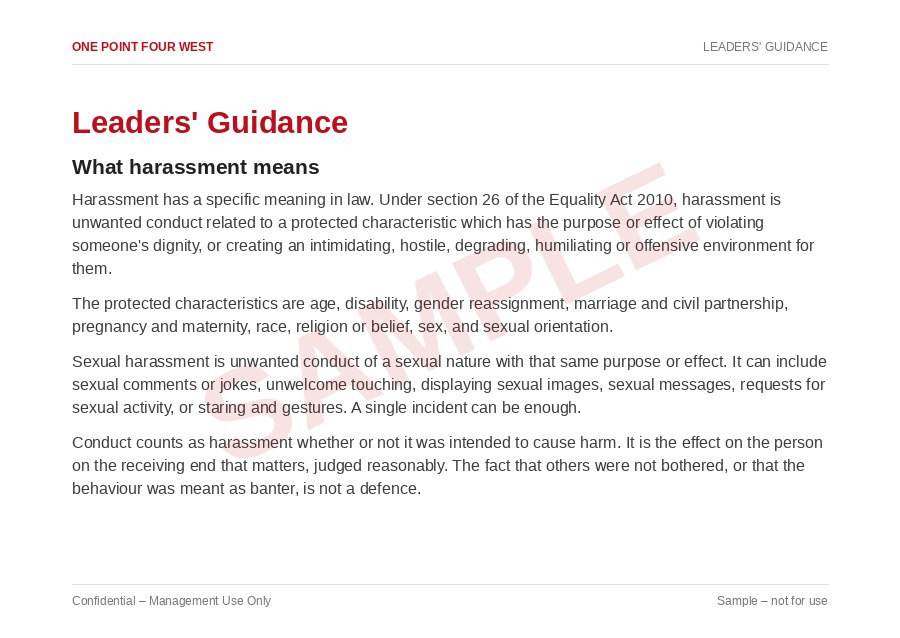
- Leaders' Guide to Preventing Harassment
Risk Assessment
- Reasonable Steps Risk Assessment
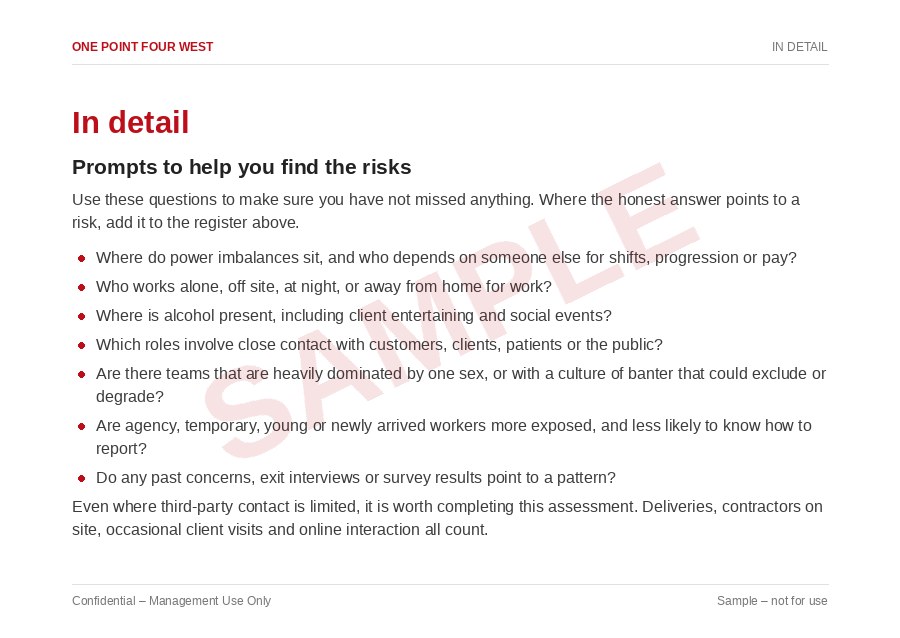
- Third-Party Harassment Risk Assessment
Reporting & Response
- Reporting and Complaint Framework
- Harassment Complaint Form
- Complaint Triage and Response Record
- Confidentiality and NDA Position Statement
Training & Culture
- Manager Briefing and Toolbox Talk
- Training Record and Attendance Log
- Staff Statement of Expected Behaviour
- Bystander Intervention Guide
Governance & Evidence
- Reasonable Steps Action Plan and Evidence Tracker
- Board and SLT Assurance Report
Training Materials
- Harassment Prevention Training (slide deck you can brand and adapt)
- 🔒 Secure payment via Stripe
- ✓ Written by a Chartered FCIPD professional
- ⬇ Instant download after customisation
Frequently asked questions
What is the employer duty to prevent sexual harassment?
Since 26 October 2024, under the Worker Protection Act 2023, employers have had a positive duty to take reasonable steps to prevent the sexual harassment of their workers. Since 30 October 2026 that duty requires all reasonable steps. Where a tribunal upholds a sexual harassment claim and finds the duty was breached, it can increase the compensation by up to 25 per cent, and the EHRC can take enforcement action even without a complaint. This pack helps you build and evidence those steps.
What changed on 30 October 2026?
From 30 October 2026, under the Employment Rights Act 2025, employers must take all reasonable steps, not just reasonable steps, to prevent sexual harassment. Employers are also liable for harassment of their staff by third parties such as customers, clients and contractors, unless they took all reasonable steps to prevent it. That covers sexual harassment and harassment related to age, disability, gender reassignment, race, religion or belief, sex or sexual orientation. The Government can also set out in regulations what all reasonable steps involves. None have been made yet, and they are expected from 2027 at the earliest, so the sensible approach is to build the evidence base now.
Does this cover harassment by customers and clients?
Yes. The pack includes a dedicated third-party harassment risk assessment, and the policy and reporting framework treat harassment by a customer, client or contractor as seriously as harassment by a colleague. The existing duty to prevent sexual harassment already covers customers and clients, and since 30 October 2026 employers have been liable for harassment of their staff by third parties, unless they took all reasonable steps to prevent it.
Do I need to be a lawyer to use this?
No. The pack is written in plain English for HR leads and managers, and it is structured around the EHRC eight-step guide so you can see exactly what to do and in what order. If a specific situation becomes serious or disputed, that is the point to take your own legal advice.
What makes this more than just a policy?
A policy on its own does not show you took reasonable steps. This pack is an evidence base: risk assessments, training records, a reporting framework, an action plan and a board assurance report, all mapped to the regulator's eight steps. It reads as a reasonable-steps file rather than a single document on a shelf.
Want help building the whole programme?
If you would rather have someone work through the risk assessments, train your managers and stand the programme up with you, that is a conversation worth having. We can scope it to your business.